
Why is my oven not heating?
If your oven is not heating, the most common causes are a burned-out bake element in an electric oven or a weak igniter in a gas oven. Other causes include a tripped breaker, a closed gas valve, a faulty temperature sensor, a worn door seal or, less often, a control board fault. If the oven heats but runs too hot or too cold, the sensor or calibration is usually to blame. This guide explains how to tell which one you have, what you can safely check, and when you need a technician for appliance repair in Sunrise, FL.
Safety first
- If you smell gas, do not touch any switches, lights or the oven controls. Leave the home right away and call your gas utility or 911 from outside.
- Switch off the oven’s circuit breaker before removing panels, racks over elements, or the oven floor.
- Let the oven cool completely before inspecting elements or the igniter.
- Do not use the oven or stovetop to heat your home.
- Never bypass a gas valve, igniter or safety part.
Gas oven vs. electric oven: how they heat
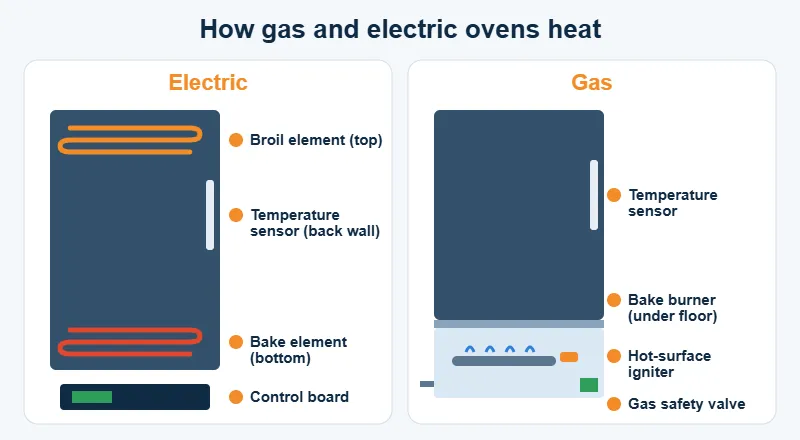
An electric oven heats with a bake element at the bottom and a broil element at the top. A temperature sensor on the back wall reports to the control board, which switches the elements on and off to hold the set temperature.
Most modern gas ovens use a hot-surface igniter. When you start the oven, the igniter heats up until it glows. Once it draws enough current, the gas safety valve opens and the burner lights. If the igniter is weak, it can glow but never get hot enough to open the valve, so no flame appears. Older gas ovens may use a standing pilot light instead.
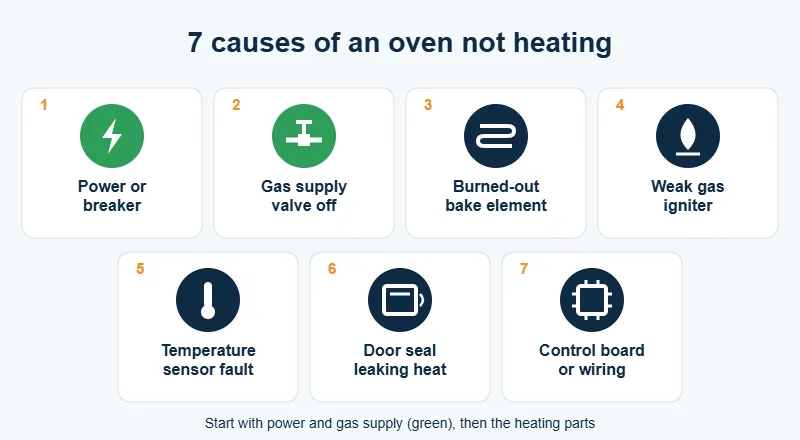
Start by checking which type you have. Then work through the causes below in order.
Cause 1: No power or a tripped breaker
What you’ll notice: The display is blank, the clock reset, or nothing happens when you press Bake. On a gas range, the stovetop burners may light with a match but the oven won’t start.
The fix: Check your electrical panel. A breaker can sit halfway between On and Off. Switch it fully off, then on. Electric ranges usually use a double breaker. If the breaker trips again when you start the oven, stop and call for service. That points to a short in an element or wiring. Also make sure the control lock or Sabbath mode is not turned on; check your owner’s manual for how to turn them off.
Cause 2: The gas supply is off (gas ovens)
What you’ll notice: The igniter glows but there is no flame, and the stovetop burners also won’t light. This often happens after a new range install, a move, or gas line work.
The fix: Check the shut-off valve on the gas line behind the range. The handle should run in line with the pipe when open. If the valve is open and nothing on the range lights, call your gas utility or a licensed technician. Do not try to adjust gas fittings yourself.
Cause 3: A burned-out bake element (electric ovens)
What you’ll notice: The broiler works but baking doesn’t, the oven only heats from the top, or food burns on top and stays raw underneath. You may see a blister, a split or a bright spot on the bottom element.
The fix: Set the oven to Bake and look at the bottom element after a minute or two. A working element glows red along its length. If it stays dark, or part of it is damaged, it needs replacing. Replacement means disconnecting wires inside the oven back wall, so with the breaker off it is a job for an experienced DIYer or a technician. Hidden-element ovens have the element under the floor panel, which makes it harder to see.
Cause 4: A weak or failed igniter (gas ovens)
What you’ll notice: The oven takes a long time to light, heats slowly, or the igniter glows orange but the burner never lights. You might hear a whoosh of delayed ignition.
The fix: Remove the oven floor panel if it lifts out and watch the igniter. If it glows but the burner does not light within a minute or two, the igniter is likely too weak to open the gas valve. If it does not glow at all, it may be burned out or have a wiring problem. Whirlpool’s guide to a gas oven not heating suggests cleaning a dirty igniter per your care guide and calling a professional for replacement. Because the job involves the gas burner, we recommend a technician do it. If your stovetop burners also have trouble, see our guide to a gas stove burner that won’t light.
Cause 5: A faulty or bumped temperature sensor
What you’ll notice: The oven heats but runs much hotter or colder than the setting, preheats too fast or never reaches temperature, or shows an error code.
The fix: Find the thin metal probe on the back wall near the top. Whirlpool says it should sit at about a 90° angle to the back wall. Gently reposition it if it was knocked by a rack. If it is straight and the problem continues, a technician can test the sensor with a meter and replace it if needed.
Cause 6: Wrong calibration or a leaking door seal
What you’ll notice: Recipes take longer than they should, food comes out under- or over-cooked, or you feel hot air escaping around the door.
The fix: Put an oven thermometer on the center rack, preheat to 350°F and check the reading after about 20 minutes. Whirlpool notes that if the reading is off by 15°F or more you can usually calibrate the oven using the steps in your manual. If it is off by around 100°F or more, call a professional. Also inspect the door gasket for tears, flat spots or gaps, and make sure the door closes fully.
Cause 7: Control board, selector or wiring fault
What you’ll notice: Elements and igniter test fine but the oven still won’t heat, buttons don’t respond, the display flickers, or error codes return after a reset. In humid South Florida homes, moisture can also be hard on electronics; see how South Florida’s humidity affects appliances.
The fix: Control boards, relays, selector switches and wiring need testing with a meter while the oven is safely opened up. This is a technician’s job. A good diagnosis matters here, because replacing a board when the real problem is a loose wire wastes money.
When to call a technician
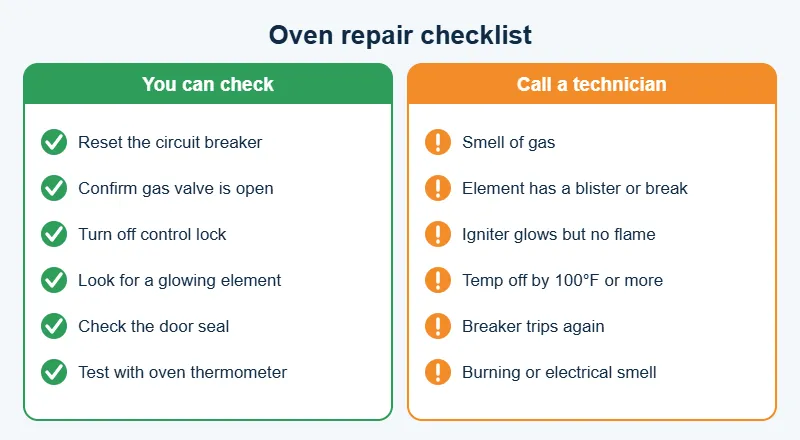
Call right away if you smell gas, see sparks, smell burning plastic, or the breaker trips again. Also call if the bake element is damaged, the igniter glows but the gas won’t light, the temperature is off by about 100°F or more, or the oven shows the same error code after a reset.
We provide oven repair in Sunrise, FL for gas and electric ovens, ranges and wall ovens, plus stove repair for cooktop problems. We serve homes in Davie, Plantation, Lauderhill, Oakland Park and Weston.
Call (954) 697-4649 or contact us online to book an oven repair visit. Have the brand, model number and any error code ready.
FAQ
Why does my oven heat on broil but not bake? In an electric oven, this usually means the bake element has burned out. In a gas oven with separate burners, it often points to a weak bake igniter.
How long should an oven take to preheat? It depends on the model, the oven size and the temperature. Check your owner’s manual for typical times. If preheating takes much longer than it used to, a weak igniter or a failing element is a common cause.
Can I replace an oven igniter myself? It is possible on some models, but it involves the gas burner and safety valve. For safety, we recommend a trained technician handle any gas oven part.
Why does my oven run hotter than the setting? A sensor that is bumped out of position, out of calibration or failing is the usual cause. Test with an oven thermometer before you adjust anything.
Is it worth repairing an oven or should I replace it? Many oven problems come down to one part, like an element, igniter or sensor, so repair is often a good option. A technician can diagnose the fault and give you a clear quote before any work starts.