
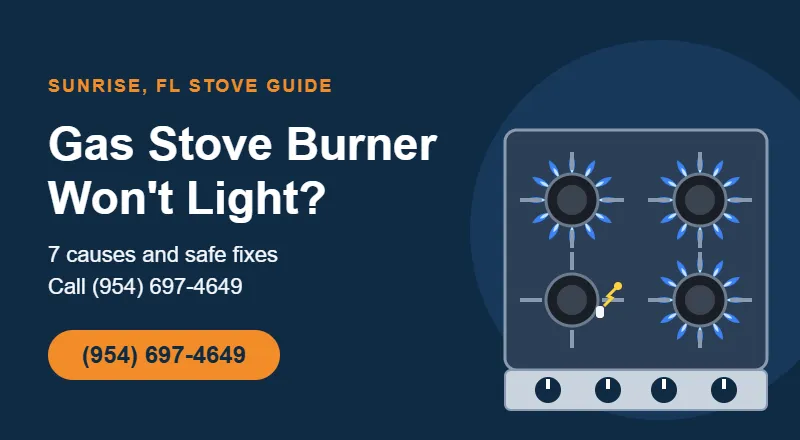
Why your gas stove burner won’t light
When a gas stove burner won’t light, the cause is usually simple: the burner cap is not sitting flat, the burner is wet or clogged from a spill or cleaning, or the igniter is dirty. Those three cover most cases and you can fix them with the stove cooled down and no tools beyond a straight pin. If no burner clicks at all, or a burner clicks nonstop, the problem is more likely power, a moisture-soaked switch or a failing spark module. And if you ever smell gas, skip the troubleshooting and follow the safety steps below first. For anything you cannot fix, our team offers appliance repair in Sunrise, FL for gas and electric stoves.
Safety first: read this before you touch the stove
- If you smell gas, do not try to light anything. Do not flip light switches, unplug appliances or use a phone inside the home. Leave the home with everyone, then call your gas utility or 911 from outside. Do not go back in until they say it is safe.
- Turn every knob to OFF and let the cooktop cool fully before removing grates, caps or burner heads.
- Unplug the stove or switch off its breaker before cleaning around the igniters. The igniter sends a high-voltage spark.
- Never enlarge the burner ports or poke them with a wooden toothpick. Broken wood can stay stuck inside.
- Do not adjust the gas valve, orifice or gas line yourself. That work belongs to a trained gas technician.
How a gas burner lights
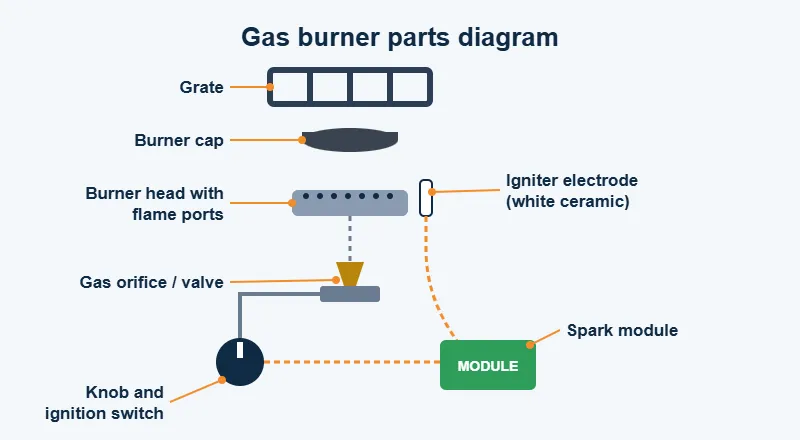
When you push and turn the knob to Lite or Ignite, two things happen. A valve lets gas flow to the burner, and a switch behind the knob tells the spark module to fire the igniter, the small white ceramic tip next to the burner. The spark jumps to the burner, gas coming out of the small ports catches, and the flame spreads around the ring. For that to work, the gas has to reach the igniter, the spark has to be strong, and the cap and head have to sit exactly where they were designed to.
Cause 1: The burner cap is off-center or on the wrong burner
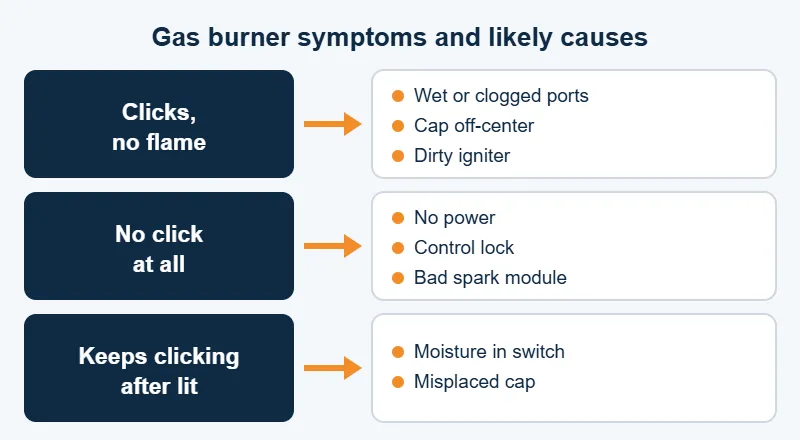
What you’ll notice: The burner clicks and you may smell a little gas, but the flame does not catch, or it lights unevenly with flames only on one side.
The fix: With the burner off and cool, lift the cap and set it back so it sits flat and centered on the burner head. On stoves with different burner sizes, make sure each cap is on its matching head; small caps on large heads (or the reverse) are a common mix-up after cleaning. Wiggle it gently. A correctly placed cap does not rock.
Cause 2: Wet burner head or ports after a spill or cleaning
What you’ll notice: The problem started right after you cleaned the stove or a pot boiled over. The burner clicks and clicks but will not light.
The fix: Remove the cap and head, shake out the water, and let them air dry completely. GE Appliances notes you can also dry the parts in a warm oven for about 30 minutes, then reinstall them. After drying, it can take several clicks before the burner lights. In South Florida’s humid air, parts can take longer to dry than you expect, which is one reason we wrote about how South Florida’s humidity affects appliances.
Cause 3: Clogged burner ports
What you’ll notice: A weak, uneven or patchy flame, gaps in the flame ring, or a burner that lights only on one side and then goes out.
The fix: Grease and food can bake into the small flame ports and the ignition port near the igniter. Clean the burner head with warm soapy water and a soft brush, then clear each port with a straight pin. Do not use a wooden toothpick, and do not make the holes bigger. Rinse, dry completely, and reinstall.
Cause 4: A dirty, cracked or loose igniter
What you’ll notice: You hear clicking but see a weak spark, or no spark at that one burner while the others work.
The fix: With the stove unplugged, wipe the igniter tip gently with a dry cloth or a soft toothbrush to remove grease. Check that the white ceramic igniter sits flush with the cooktop; on some models it can be pressed and twisted back into place. If the ceramic is cracked or the wire is damaged, the igniter needs to be replaced. That job involves the stove’s wiring, so it is best done by a technician.
Cause 5: No clicking at all: power or control lock
What you’ll notice: Turning any knob gives no click on any burner.
The fix: Most gas stoves still need electricity for the spark. Check that the stove is plugged in, that the outlet works, and that the breaker or GFCI has not tripped. On some models with electronic controls, a control lock can be on after a power outage; your owner’s manual explains how to turn it off. During a power outage, some models can be lit with a match, but only follow the method in your own owner’s manual. If the stove has power and nothing clicks, the spark module or wiring may have failed.
Cause 6: Clicking that won’t stop
What you’ll notice: The igniters keep clicking after the burner lights, or even with every knob turned off.
The fix: This usually means moisture got into the ignition switches behind the knobs, often after a spill or wiping the control panel with a wet cloth. Turn the stove off and let it dry for a day. Whirlpool suggests pulling off the knobs and blowing cool air from a hair dryer onto the knob shafts to speed drying. If the clicking continues once everything is dry, a switch or the spark module is likely faulty and needs replacement.
Cause 7: Gas supply or a new installation problem
What you’ll notice: None of the burners light even though they all click, or a brand-new stove will not light right after it was installed.
The fix: On a new stove, air in the gas line can delay the first light; turning on one burner for a short time usually clears it. Make sure the gas shut-off valve behind the stove is open. If it still will not light, or if the stove was just moved or installed, do not try to adjust connections yourself. A trained technician should check the gas connection, regulator and valves, and test for leaks. If you are planning a new range, a professional gas stove installation also protects the connection from day one.
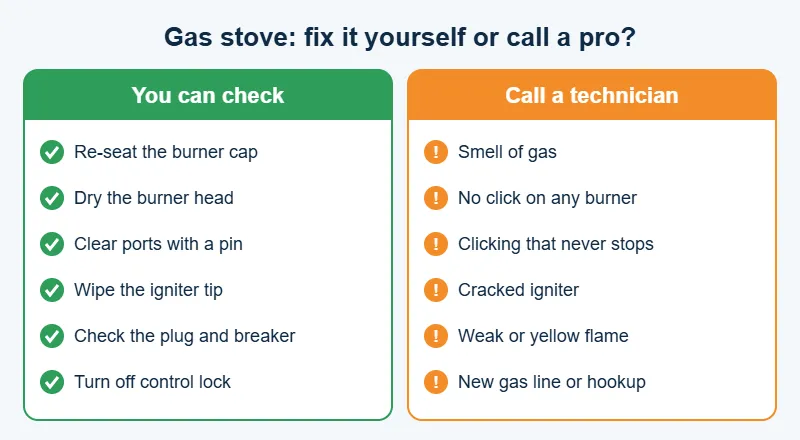
When to call a technician
Call right away if you smell gas (after leaving the home and calling your gas utility), if no burner clicks even with power, if the clicking never stops after the parts are dry, if the igniter is cracked, or if the flame is weak, yellow or lifting off the burner. These point to parts like the spark module, ignition switches, igniters or gas valves, which need testing and safe replacement.
We provide stove repair in Sunrise, FL for gas and electric ranges and cooktops, and we can also check your oven on the same visit through our oven repair service. We serve homes across Davie, Plantation, Lauderhill, Oakland Park and Fort Lauderdale.
Call (954) 697-4649 or contact us online to book a visit. Ask about same-day appointments when you call.
For a manufacturer’s step-by-step guide, see GE Appliances: common causes for slow ignition or clicking on surface burners.
FAQ
Why does my gas stove click but not light? The most common reasons are a burner cap that is not sitting flat, a wet burner after cleaning, or clogged ports. Re-seat the cap, dry the parts, and clear the ports with a straight pin.
Is it safe to light a gas burner with a match? Only if your owner’s manual describes that method for your model, such as during a power outage. Never do it if you smell gas.
Why does only one burner not light? When the other burners work, the problem is almost always at that burner: its cap, head, ports or igniter. Power and gas supply problems usually affect every burner.
What should I do if I smell gas near the stove? Do not light anything or use switches. Leave the home, then call your gas utility or 911 from outside. Have the stove checked before using it again.
Can I use a stove with a burner that won’t light? You can use the other burners if there is no gas smell, but keep the broken burner’s knob off. Get it fixed soon, since a burner that lets gas out without lighting is a safety risk.