
Why is my electric stove burner not working?
If one electric stove burner is not working while the others heat normally, the cause is almost always one of three parts: the coil element itself, the receptacle block it plugs into, or the infinite switch behind the knob. If none of the burners work, look first at power: the breaker, the outlet and the range cord. Many of these problems take only a few minutes to narrow down, and you can do the first checks safely with the stove off and cool. This guide walks through each cause the way our technicians do on a service call for appliance repair in Sunrise, FL, so you know what to try and when it is time for a pro.
Safety first
- Turn every knob to OFF and let the cooktop cool fully before you touch a coil.
- For anything past lifting out a coil, switch off the range’s breaker at the panel or unplug the range. Electric ranges run on 240 volts, which can cause a serious shock.
- Never touch a coil or socket that is sparking, and never pour water on an electrical fire. Turn off the breaker, cover the pan with a lid, and call 911 if the fire spreads.
- Do not use a burner with a cracked or bubbled coil.
How a coil burner gets power
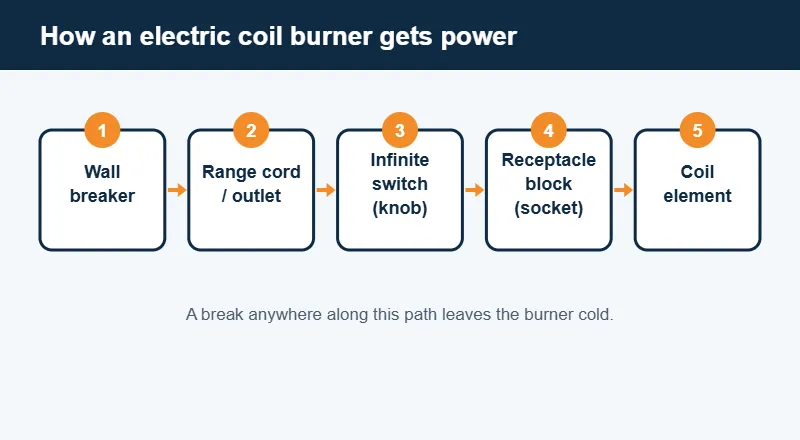
Power comes from a 240-volt breaker, through the range cord, to the infinite switch on the control panel. When you turn the knob, that switch cycles power on and off to control heat. Power then runs through wiring to the receptacle block, the small socket under the cooktop, and from there into the two prongs on the end of the coil. A break anywhere along that path leaves the burner cold. Because the coils are usually interchangeable between burners of the same size, you can often find the weak link without any tools.
Cause 1: The coil is not seated in its socket
What you’ll notice: The burner was fine until you cleaned the drip pans, and now it heats slowly, flickers or does nothing.
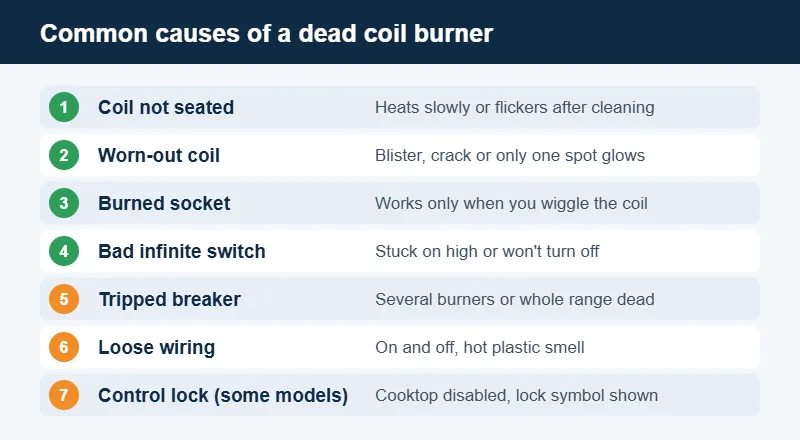
The fix: With the stove off and cool, lift the edge of the coil opposite the socket and pull it straight out. Check that the drip pan is sitting flat and not pushing the coil up. Push the terminal ends firmly and straight back into the socket until the coil sits level. A coil that wobbles or sits crooked may not be making full contact.
Cause 2: A worn-out or burned coil element
What you’ll notice: Only one spot of the coil glows, the coil has a blister, crack or bulge, or it stays dark at every setting.
The fix: Do the swap test. Take the coil from a working burner of the same size and plug it into the dead socket. If the borrowed coil heats, the original coil has failed and needs replacing. Coils are sold by model, so match the size, number of turns and terminal style to your range’s model number. If the borrowed coil also stays cold, the coil is fine and the problem is deeper in the socket, switch or wiring.
Cause 3: Normal cycling on newer coils
What you’ll notice: The burner heats, but the inner part goes dark and comes back, or it glows less brightly than your old stove did.
The fix: This may not be a fault at all. KitchenAid notes that electric coil ranges built since June 2018 have temperature-limiting features: the outer coil stays on but may glow less, while the inner coil cycles on and off. If your pans come to temperature and food cooks normally, the burner is working as designed.
Cause 4: A burned or loose receptacle block
What you’ll notice: The burner works only when you wiggle the coil, you see black or melted spots around the socket, or the coil’s prongs are pitted.
The fix: With the breaker off, lift the cooktop or remove the drip pan and look at the socket. A socket that is scorched, cracked or loose will not hold the coil prongs tightly, and that poor contact creates more heat and more damage. A burned socket should be replaced, and the coil that was plugged into it should usually be replaced too, because pitted prongs will ruin a new socket. If the wire behind the socket is also burned, this is a job for a technician.
Cause 5: A failed infinite switch
What you’ll notice: A good coil and a clean socket, but the burner stays off, stays on high no matter the setting, or will not turn off at all.
The fix: Each burner has its own infinite switch behind the knob. Contacts inside wear out over years of clicking on and off. A burner stuck on high or one that will not shut off is a safety issue: turn off the range’s breaker and do not use that burner until the switch is replaced. Testing a switch means checking it with a multimeter with power off, then sometimes with power on, which is why most homeowners leave this one to a technician. Replacement switches are model-specific.
Cause 6: A tripped breaker or power problem
What you’ll notice: Several burners are dead, or the whole range is dead, including the clock and oven.
The fix: Electric ranges usually sit on a double breaker. Check the panel for a tripped breaker and reset it once. If half the range works and half does not, one side of the 240-volt supply may be out. A breaker that trips again right away, a scorched outlet behind the range, or a damaged range cord points to an electrical fault that needs a technician or a licensed electrician. Some ranges also have a control lock that disables the cooktop, so check your manual if the display shows a lock symbol.
Cause 7: Loose or burned wiring
What you’ll notice: The burner works on and off, you smell hot plastic, or the problem started after the range was moved.
The fix: Wires between the switch and the socket can loosen, chafe or burn at their terminals, especially after years of heat. Humidity in South Florida homes can also speed up corrosion on terminals, as we explain in our post on how South Florida’s humidity destroys appliances faster. Wiring repairs mean opening the control panel or cooktop on a 240-volt appliance, so book a repair.
When to call a technician
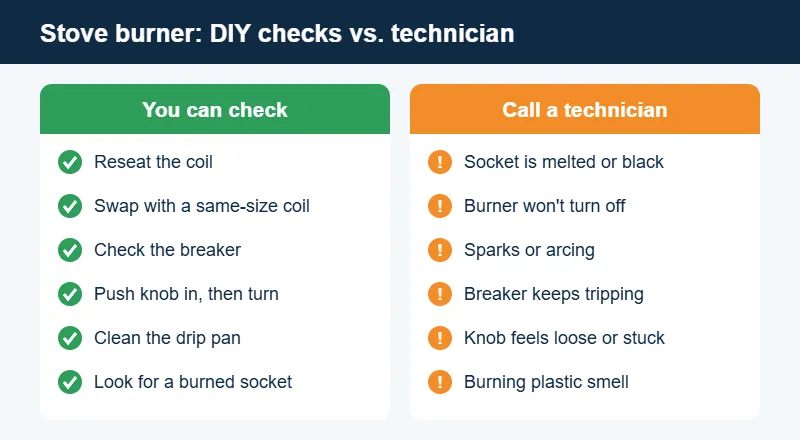
Call right away if a burner will not turn off, if you see sparks or melted plastic, if the breaker keeps tripping or if you smell burning wiring. Call for service too if the swap test shows the coil is fine but the burner still will not heat, since that leaves the socket, switch or wiring.
We provide stove repair for electric coil, glass-top and gas ranges, plus oven repair when the bake or broil element is the problem. Besides Sunrise, our technicians serve Plantation, Tamarac, Lauderhill, Weston and Fort Lauderdale. If you have a gas cooktop instead, see our guide on why a gas stove burner won’t light.
Call (954) 697-4649 or contact us online to book a visit. Have your range’s model number ready; it is usually on a label inside the oven door frame or under the cooktop.
FAQ
Why does only one burner on my electric stove not work? When only one burner fails, the problem is limited to that burner’s coil, socket, switch or wiring. Swap in a same-size coil from a working burner to see whether the coil is at fault.
How do I know if my stove burner or the socket is bad? If a borrowed coil heats in the dead socket, the original coil is bad. If the borrowed coil stays cold, or the socket looks black, cracked or loose, the socket or the switch behind it is the likely cause.
Can I replace an electric stove coil myself? Usually, yes. Coils on most coil-top ranges plug in and pull out. Turn the burner off, let it cool, and buy the exact coil for your model number. Sockets, switches and wiring are better left to a technician.
Why does my electric burner turn off and on by itself? On newer ranges, the inner coil is designed to cycle to limit temperature. Older burners also cycle on lower settings. If the burner cannot reach a boil on high, the switch may be worn.
Is it safe to use a burner that won’t turn off? No. Turn off the range’s breaker and leave it off until the infinite switch is replaced.