

Why is my dishwasher not draining?
If your dishwasher is not draining, the cause is usually a clog somewhere between the tub and your sink drain: a dirty filter, a clogged garbage disposal, a kinked drain hose or a blocked air gap. A new disposal with its knockout plug still in place is another classic cause. Less often, the drain pump or check valve has failed. Most of these you can check in about 20 minutes with no tools beyond a towel and a cup. This guide walks through each cause in the order we check them on service calls for appliance repair in Sunrise, FL, and tells you when it is time to stop and call a technician.
How a dishwasher drains
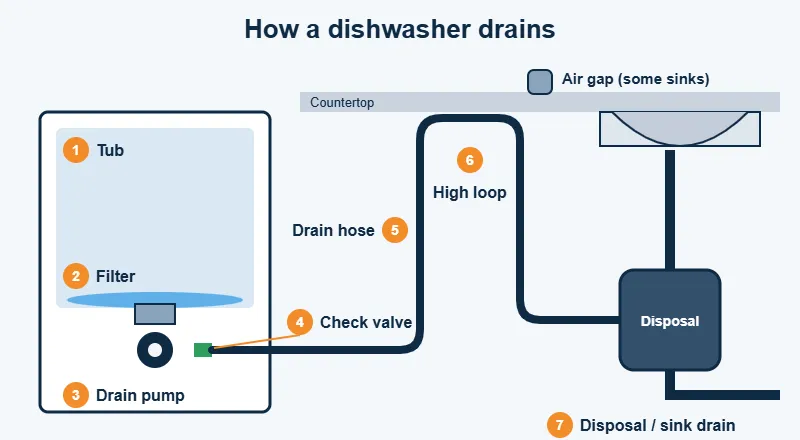
At the end of each wash and rinse, the drain pump pushes dirty water out of the sump at the bottom of the tub. The water passes through the filter, through a one-way check valve, and into the drain hose. The hose runs up under the counter in a high loop, or to an air gap on the sink, and then connects to the garbage disposal or the sink drain line.
The high loop and air gap stop dirty sink water from flowing back into the dishwasher. Any blockage along this path can leave water standing in the tub. That is why the fix is usually about finding where the water stops, not replacing parts.
Safety first
- Turn the dishwasher off and switch off its circuit breaker before you reach into the sump or touch the pump area.
- Never put your hand inside a garbage disposal. Turn the disposal off at the switch and breaker before looking inside, and use tongs or pliers to remove objects.
- Standing water can be hot right after a cycle. Let it cool first.
- Bail water out with a cup and soak up the rest with towels before removing the filter.
- Do not pour chemical drain cleaners into a dishwasher. They can damage seals and plastic parts.
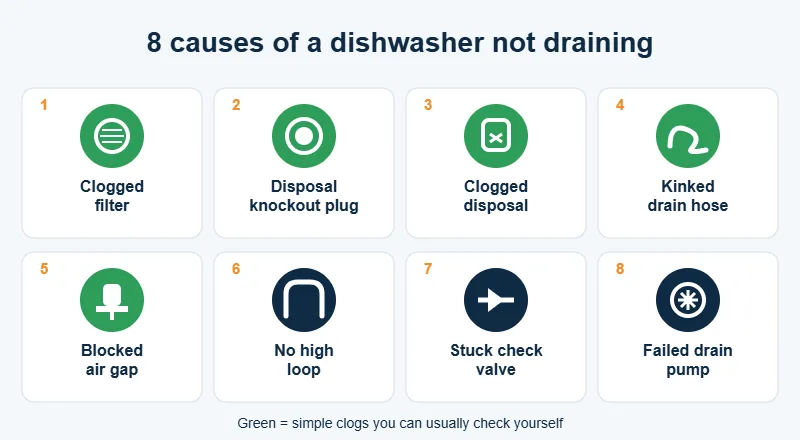
Cause 1: A clogged filter
What you’ll notice: A few inches of cloudy water in the bottom after a cycle, food bits on the filter screen, and often a sour smell. The problem may build slowly over weeks.
The fix: Most dishwashers made in the last decade have a manual filter under the lower spray arm. Pull out the lower rack, twist the cylindrical filter counterclockwise and lift it out along with the flat mesh screen. Rinse both under warm water and scrub gently with a soft brush. Clear any glass, seeds or labels from the sump opening, then lock the filter back in place. Cleaning the filter once a month helps prevent this. Our guide to a dishwasher not cleaning dishes covers filter care in more detail.
Cause 2: The garbage disposal knockout plug was never removed
What you’ll notice: The dishwasher or the disposal is brand new, and the dishwasher has never drained properly since the installation.
The fix: New disposals ship with a plastic knockout plug inside the dishwasher inlet. Whirlpool’s support page on a newly installed dishwasher not draining calls this a commonly missed step. With the power off, loosen the hose clamp, pull the drain hose off the disposal inlet, and tap the plug out with a screwdriver and hammer. Then fish the loose plug out of the disposal with pliers, reattach the hose and tighten the clamp.
Cause 3: A clogged garbage disposal or sink drain
What you’ll notice: The kitchen sink also drains slowly, or water backs up into the sink when the dishwasher drains.
The fix: Run the disposal with cold water for 20 to 30 seconds to clear food that blocks the dishwasher inlet. If the sink itself is clogged, the dishwasher has nowhere to send its water. Clear the sink drain first with a plunger (cover the dishwasher side if you have a double sink), then run a drain or rinse cycle.
Cause 4: A kinked or clogged drain hose
What you’ll notice: No backup in the sink, a clean filter, but water still stays in the tub. This often happens right after the dishwasher was pushed back into place or cabinet items were moved.
The fix: Look under the sink and follow the ribbed drain hose. Straighten any sharp bend or crushed section. If you can reach it, disconnect the hose at the sink end and blow through it or flush it with water over a bucket. A hose that is cracked or keeps kinking should be replaced.
Cause 5: A blocked air gap
What you’ll notice: Water spurts out of the small chrome cap on the back of your sink during the drain cycle.
The fix: Pull or twist off the cap, unscrew the plastic cover underneath and clean out food and grease with a small brush or a pipe cleaner. Not every home has an air gap. Local plumbing codes decide whether one is required.
Cause 6: The drain hose has no high loop
What you’ll notice: Dirty water creeps back into the tub between cycles, or the dishwasher smells even with a clean filter.
The fix: Without an air gap, the hose should rise in a high loop under the counter before it drops to the drain. Secure the hose to the underside of the counter or the cabinet wall with a strap. Check your installation manual for the exact height for your model.
Cause 7: A stuck check valve
What you’ll notice: The pump runs and you hear water moving, but the level in the tub barely drops, or water flows back in afterward.
The fix: The check valve is a small flap or ball that lets water out but not back in. On many models it sits under the filter assembly or where the drain hose meets the pump. Food or grease can stick it closed or open. A technician can remove, clean or replace it. On some models this means taking off the lower kick panel and pump housing.
Cause 8: Failed drain pump or control problem
What you’ll notice: A loud hum or buzz with no water moving, a grinding or scraping noise, or complete silence during the drain part of the cycle. Some models show a drain error code.
The fix: A humming pump is often jammed by a piece of glass or a fruit pit, which can sometimes be cleared through the sump. A pump that is silent, scrapes or keeps failing usually needs to be tested and replaced. Less often the problem is a drain solenoid, wiring, the door latch switch or the control board. These need a meter and safe access behind the panels, so they are a job for a technician.
How to drain the water before you start
- Switch off the breaker.
- Lay towels on the floor in front of the door.
- Bail water into a bowl with a cup, then sponge out the last bit.
- Remove and clean the filter (Cause 1).
- Restore power and run a short rinse or “Cancel/Drain” cycle. Many models drain when you press Start/Cancel and close the door; check your manual for yours.
When to call a technician
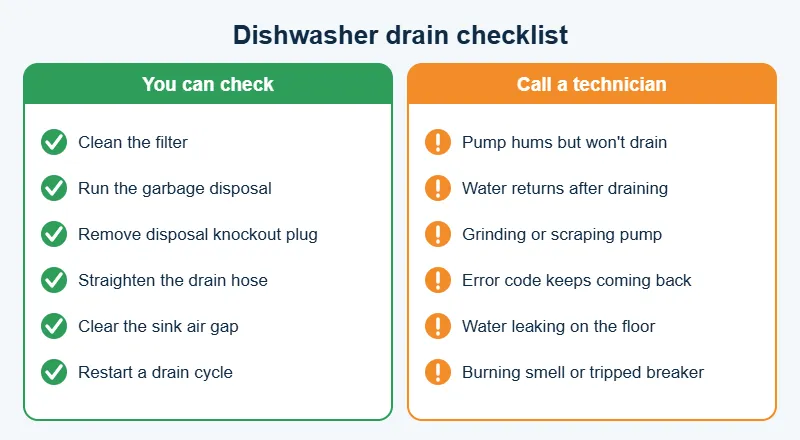
Call for service if the filter, disposal, hose and air gap are clear but water still stays in the tub, if the pump hums, grinds or makes no sound, or if the same drain error keeps coming back. Also call right away if water leaks onto the floor, you smell burning, or the breaker trips. A leaking dishwasher can damage cabinets and subfloors quickly.
Our technicians handle dishwasher repair in Sunrise, FL and nearby Plantation, Fort Lauderdale, Tamarac and Weston. If your laundry room has a similar problem, see our guide to a washing machine not draining, and we also offer washing machine repair.
Call (954) 697-4649 or contact us online to book a visit. Tell us the brand, model number and what you see in the tub so the technician can come prepared.
FAQ
Is it normal to have a little water in the bottom of my dishwasher? A small amount of clear water around the sump under the filter is normal on many models. It keeps the seals moist. More than about a cup, or dirty water sitting in the tub, means something is blocking the drain.
Can I use vinegar or baking soda to unclog a dishwasher? They can help loosen grease and odors once the water has drained, but they will not clear a solid clog, a kinked hose or a failed pump. Clean the filter and check the disposal first.
Why does my dishwasher drain into the sink? Usually the sink drain or the disposal is clogged, so the water takes the easiest path out. A missing high loop or a blocked air gap can also cause it.
Can I run the dishwasher if it is not draining? It is best not to. Each new cycle adds more water and can overflow onto the floor. Fix the clog or call for repair first.
Do you offer same-day dishwasher repair? Same-day visits depend on the schedule that day. Call (954) 697-4649 early in the day for the best chance of a same-day appointment in Sunrise and nearby cities.