

Why your dishwasher is not cleaning dishes
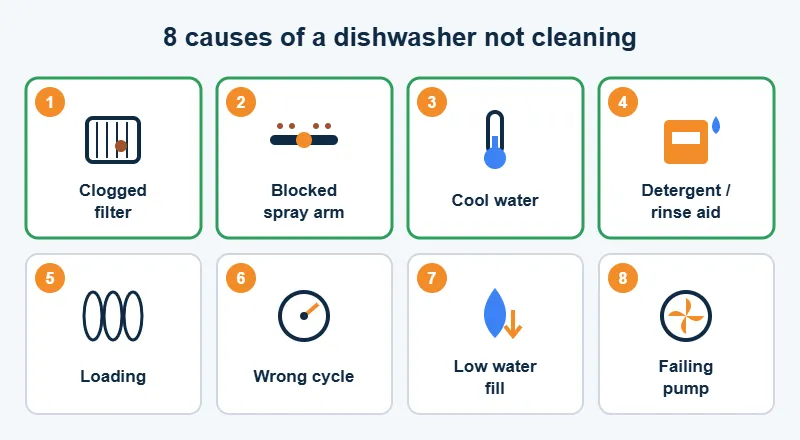
If your dishwasher is not cleaning dishes, the cause is usually one of four things: a clogged filter, blocked spray arms, water that is not hot enough, or the wrong detergent. All four are things you can check yourself in under 30 minutes. If the dishes are still dirty after that, the problem is more likely a part such as the wash pump, water inlet valve or heating element, and that is when you need a technician. Below, we walk through eight causes in order, starting with the easiest. If you would rather have it looked at today, our team provides appliance repair in Sunrise, FL and the nearby cities.
How a dishwasher actually cleans
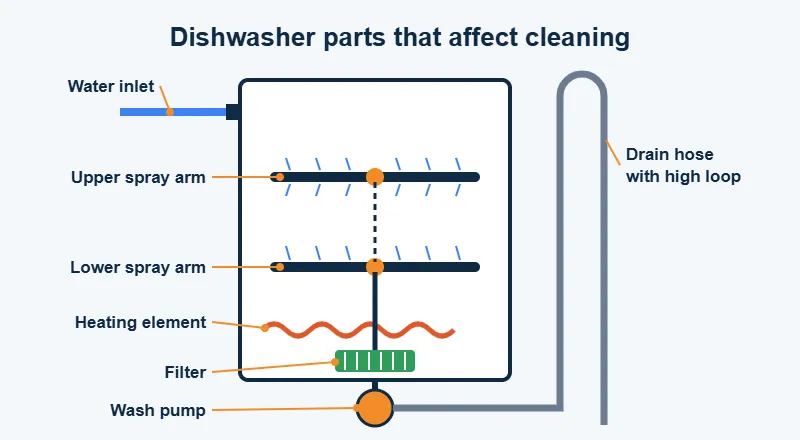
A dishwasher fills with a small amount of water, heats it, and a wash pump pushes it up through spinning spray arms. The spray hits the dishes, runs back down through a filter, and gets pumped around again. At the end, the dirty water drains out and clean water rinses the load.
That means good results need four things at once: enough water, hot water, strong spray, and a clean filter. When any one of them is weak, you see the same symptoms: food stuck to plates, gritty film on glasses, or a top rack that comes out dirtier than the bottom.
Cause 1: A clogged filter
What you’ll notice: Small bits of food on dishes, a sour smell when you open the door, or dirty water left at the bottom after a cycle.
The fix: Most newer dishwashers have a manual filter at the bottom of the tub that you have to clean yourself. Twist it out (check your owner’s manual for your model), then wash it under running water with a soft brush and a little dish soap. Clean the area under it with a paper towel. Put it back until it locks. GE recommends cleaning the filters about once a month, and more often if you do not scrape plates well.
Cause 2: Blocked or stuck spray arms
What you’ll notice: One rack cleans fine and the other does not. Often the top rack is the problem.
The fix: Spin each spray arm by hand. It should turn freely. If something is hanging down from the rack, like a pan handle or a tall cutting board, it can stop the arm. Pull the arms off (most unclip or unscrew) and look at the small holes. Clear any seeds, glass chips or mineral scale with a toothpick or paper clip, then rinse the arm under the tap. If an arm is cracked or will not spin even when clean, it needs to be replaced.
Cause 3: Water that is not hot enough
What you’ll notice: Greasy film on plates, detergent pods that do not fully dissolve, and cloudy glasses.
The fix: Detergent needs hot water to work. GE Appliances says the water reaching the dishwasher should be at least 120°F. Before you start a cycle, run the hot water at your kitchen sink until it is hot, so the dishwasher fills with hot water instead of the cold water sitting in the pipe. You can check the temperature with a cooking thermometer. Also try not to run the dishwasher while someone is showering or the washing machine is filling, since they pull hot water at the same time.
Cause 4: Wrong detergent, no rinse aid, or hard-water film
What you’ll notice: White or cloudy film on glasses, spots, and dishes that feel rough.
The fix: Use only automatic dishwasher detergent. Regular dish soap makes too many suds and should never go in a dishwasher. Keep powder detergent dry and replace old boxes, since detergent that has absorbed moisture loses strength (easy to happen in our humid South Florida air). Keep the rinse aid dispenser full; rinse aid helps water sheet off dishes and reduces spots from minerals. If you have hard water, you may need to adjust the detergent amount for your water, as your owner’s manual describes. Running an empty cycle with a dishwasher cleaner can also clear built-up film inside the tub.
Cause 5: Loading that blocks the spray
What you’ll notice: Dirt in the same spots every time, often inside bowls and on items in the middle of the rack.
The fix: Face the dirty side of plates toward the center and the spray. Do not nest bowls or crowd the racks. Keep large pans and trays along the sides or back so they do not block the spray or the detergent door. Scrape off big food pieces, but you do not need to fully pre-rinse; many dishwashers use sensors and may run a shorter cycle if dishes look too clean going in.
Cause 6: The wrong cycle for the load
What you’ll notice: Baked-on food stays on pots and casserole dishes, but light loads come out fine.
The fix: Quick or light cycles are made for lightly soiled dishes. For pots and pans, use a heavy or pots-and-pans cycle and turn on any extra heat or high-temperature option your model has. On models with a half-load or zone option, make sure it is not turned on by accident, or only one rack will get full spray.
Cause 7: Not enough water coming in
What you’ll notice: You hear the dishwasher run, but there is very little water in the bottom when you open it mid-cycle. Dishes come out barely wet or still dirty.
The fix: First make sure the water valve under the sink is fully open. Very low house water pressure can also stop a full fill. If the valve is open and pressure is normal, the water inlet valve or the float switch may be faulty. These parts are behind the kick plate and connect to water and power, so this is a job for a technician.
Cause 8: A weak wash pump, failing heater, or drain problem
What you’ll notice: A humming sound with little or no spraying, water that never gets hot, or dirty water left standing after the cycle ends.
The fix: If the wash pump motor is weak, the spray arms cannot push water hard enough. If the heating element or its thermostat fails, water stays cool during the wash. If the dishwasher does not drain well, dirty water gets sprayed back onto the dishes. Each of these needs testing with a meter and part replacement, so it is best handled by a pro. If standing water is your main symptom, the same drain hose and pump checks we cover in our guide on a washing machine not draining also apply to dishwashers.
Safety notes before you start
- Turn off power at the breaker or unplug the dishwasher before you remove the kick plate or touch anything below the tub.
- Let the dishwasher cool. The heating element and water can stay hot after a cycle.
- Watch for broken glass in the filter area. Use gloves.
- Never use regular dish soap to “boost” a cycle. It can flood your floor with suds.
- If you see water under the dishwasher or smell burning plastic, stop using it and call for service.
When to call a technician
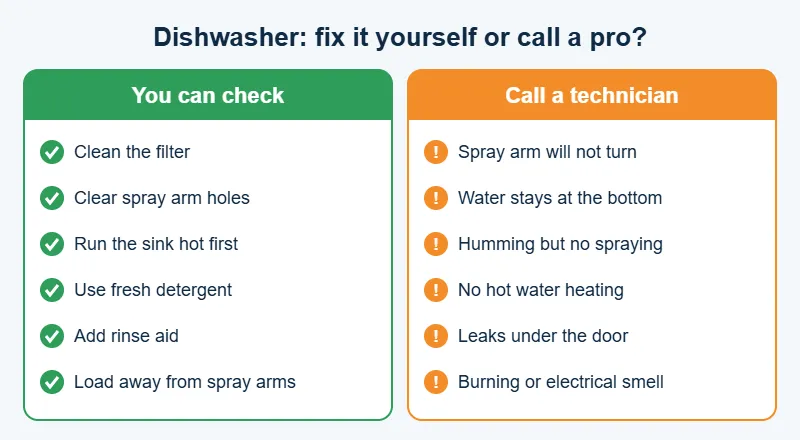
Call a technician if you have cleaned the filter and spray arms, run hot water first, used fresh detergent, and the dishes are still dirty after two or three cycles. You should also call if a spray arm will not turn, the dishwasher hums without spraying, water does not drain, or the tub never gets hot.
Our technicians handle dishwasher repair in Sunrise, FL and nearby areas, including Plantation, Fort Lauderdale, Tamarac, Davie and Weston. We work on most major brands, including Samsung, GE, Whirlpool, Bosch and LG. If your laundry machines are acting up too, we also offer washing machine repair on the same visit.
Call us at (954) 697-4649 or send us a message to book a visit. Ask about same-day availability when you call.
For more model-specific tips, see the manufacturer guide from GE Appliances on a dishwasher not washing properly.
FAQ
Why are dishes on the top rack still dirty? The upper spray arm is usually blocked or not turning. Check that nothing on the rack hangs down into its path, and clear the holes in the arm.
How often should I clean my dishwasher filter? About once a month is a good rule for most homes. Clean it more often if you run the dishwasher daily or load plates with a lot of food left on them.
Why are my glasses cloudy after a wash? Cloudy glasses usually come from hard-water minerals, too little rinse aid, or water that is not hot enough. Fill the rinse aid, run the sink hot first, and use fresh detergent.
Should I pre-rinse dishes before loading them? Scrape off large food pieces, but you do not need to fully rinse. Many dishwashers use sensors, and very clean dishes can lead to a shorter, weaker cycle.
Is it worth repairing a dishwasher that is not cleaning? Often, yes. Many cleaning problems are fixed with cleaning or one part, such as a spray arm, inlet valve or pump. A technician can test the parts and tell you what is wrong before you decide.