
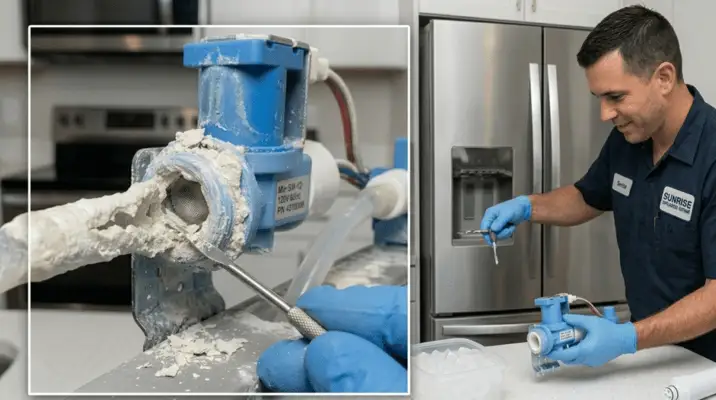
Your refrigerator is not making ice, and in Sunrise, FL where summer heat lasts most of the year, that is not a minor inconvenience. The most common reasons a refrigerator stops making ice in Sunrise are a clogged water inlet valve caused by hard water mineral buildup, a frozen fill tube, a dirty or expired water filter, an incorrect freezer temperature, or a failed ice maker module. Most of these problems are fixable with professional repair on the same day.
This guide covers every cause in detail, explains what you can safely check yourself, and tells you exactly when to call a licensed ice maker repair technician serving Sunrise and the surrounding Broward County area.
Why Ice Maker Problems Are So Common in Sunrise, FL
If you feel like your ice maker is giving you more trouble than it should, you are probably not imagining it. Sunrise and the broader Broward County area have some of the hardest water in South Florida. Hard water carries high concentrations of calcium, magnesium, and other dissolved minerals that silently work against your ice maker over time.
Florida’s heat makes things worse. Refrigerators here run their compressors harder to stay cool. This extra strain creates more wear on internal components over time.
This constant cycling wears down temperature sensors and defrost systems faster. Ice maker modules fail sooner here than in cooler climates.
It is one reason why homeowners in Sunrise often find themselves dealing with ice maker failures several years earlier than the national average appliance lifespan would suggest.
Understanding this local context is important because it changes how you approach the repair. A solution that works in a city with soft water may not address the root cause in a Sunrise home where mineral buildup is the underlying driver.
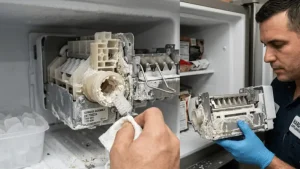
Signs Your Refrigerator Has an Ice Maker Problem
1, Ice maker issues usually give you a warning before they completely stop working. Catching the early 2 signs can mean the difference between a simple repair and a full ice maker module replacement.
2, Your ice maker is producing less ice than it used to, even though nothing obvious has changed.
3, The ice cubes coming out are smaller than normal or hollow in the center.
4, Ice production has slowed down significantly and cycles seem infrequent.
5, You hear the ice maker attempting to cycle but no ice drops into the bin.
5, The water dispenser on the door still works, but the ice maker produces nothing.
6, There is a layer of frost or ice buildup inside the freezer compartment near the ice maker unit.
7, The ice tastes strange, smells musty, or has a chemical aftertaste — this usually points to a water filter replacement that is long overdue.
8, Any of these signs, especially in combination, indicate that professional ice maker repair in Sunrise FL is needed before the issue progresses further.
9, The refrigerator makes a clicking or buzzing sound when the ice maker tries to fill.
10, Any of these signs, especially in combination, indicate that professional ice maker repair in Sunrise FL is needed before the issue progresses further.
The Most Common Reasons a Refrigerator Stops Making Ice in Sunrise, FL
1. Mineral Buildup in the Water Inlet Valve
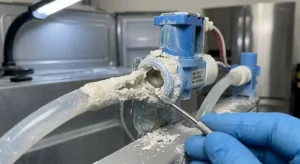
A solenoid operates the water inlet valve. operated component at the back of your refrigerator that controls water flow into the ice maker. When you press the ice dispenser or when the ice maker calls for water, this valve opens briefly to allow the precise amount of water needed to fill the ice mold.
As the screen narrows, water pressure to the ice maker drops. The ice mold receives less water than it needs, producing small or hollow cubes. Eventually the screen becomes blocked enough that no water gets through at all.
This is the single most common cause of ice maker failure in South Florida homes, and it is entirely driven by the local water supply. Replacing the water inlet valve and addressing the mineral buildup restores full ice production in most cases.
2. Expired or Clogged Water Filter
Nearly every modern refrigerator with a built-in ice maker also has a water filtration system. The filter removes sediment, chlorine, and contaminants from the water before it reaches both the dispenser and the ice maker.
In most parts of the country, changing this filter every six months is a reasonable guideline. In Sunrise and Broward County however, the combination of hard water and municipal water treatment chemicals means the filter can become restrictive sooner than that. Once the filter reaches capacity, it reduces water flow to the ice maker significantly.
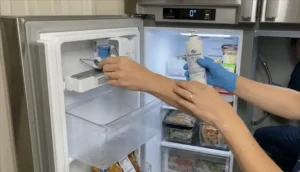
A clogged filter is one of the easiest causes to address. Most refrigerator water filters are located inside the upper right corner of the refrigerator compartment, in the base grille at the bottom, or inside the freezer. Replacing it with a genuine manufacturer filter for your specific brand and model restores normal water pressure to the ice maker.
This is also one of the few ice maker issues homeowners can handle themselves. If you cannot remember the last time you changed your filter, it has almost certainly been too long.
3. Frozen Fill Tube
The fill tube is the small plastic or rubber tube that carries water from the water inlet valve at the back of the refrigerator to the ice mold inside the freezer. In some situations, especially when the freezer temperature is set slightly too low or there is a defrost system issue, water freezes inside this tube before it reaches the mold.
When the fill tube is frozen, the ice maker attempts to cycle but receives no water. You may hear the motor running and the ice maker arm moving, but nothing comes out. This problem is particularly common in French door refrigerators where the fill tube runs a longer path and is more exposed to cold freezer air.
Thawing a frozen fill tube is possible but must be done carefully. Using too much heat can warp or damage the plastic components. A technician can defrost the tube safely, identify why it froze in the first place, and correct the underlying temperature or defrost issue to prevent it from happening again.
4. Incorrect Freezer Temperature
Ice makers are engineered to operate within a specific temperature window. For the ice mold to freeze properly and release cubes on schedule, the freezer needs to maintain a temperature at or near zero degrees Fahrenheit.
If the freezer temperature is above five degrees Fahrenheit, the ice mold will not freeze quickly enough and the ice maker may not complete its cycle. If the temperature is too low, below negative four degrees Fahrenheit, the fill tube can freeze solid as described above.
Temperature problems in the freezer often point to a related appliance issue such as a failing defrost system, dirty condenser coils, a malfunctioning evaporator fan, or a door seal that is no longer airtight. In Florida, door gaskets on refrigerators take significant wear from the heat and humidity, and a deteriorating gasket allows warm air to enter the freezer regularly, raising the internal temperature enough to affect ice production.
5. Ice Maker Module or Control Board Failure
The ice maker module is the electronic assembly that controls the entire ice making cycle: when to call for water, how long to freeze, when to harvest the cubes, and when to start the next cycle. When this module fails, the ice maker may stop cycling entirely, get stuck at one phase of the cycle, or behave erratically.
Control board issues occur more frequently in refrigerators that have been exposed to power fluctuations. In Sunrise and Broward County, brief power interruptions during summer storm season can cause voltage spikes that damage the ice maker control board or the main refrigerator control board that communicates with it.
Diagnosing a module failure requires proper testing equipment and knowledge of your specific refrigerator model. It is not a repair that can be done safely without professional tools.
6. Faulty Ice Maker Sensor or Bin Switch
Most refrigerator ice makers use a sensor or mechanical arm to detect when the ice bin is full. When the bin reaches capacity, the sensor signals the ice maker to pause production until ice is dispensed and the level drops.
If this sensor arm gets stuck in the raised position, the ice maker thinks the bin is full. It stops producing ice even when the bin is completely empty.
This can happen if the ice bin was removed and replaced incorrectly, if a large piece of ice is jamming the arm, or if the sensor itself has failed electronically.
The fix ranges from simply repositioning the arm or the bin to replacing the sensor assembly, depending on what is causing the malfunction.
7. Low Household Water Pressure
Ice makers require a minimum water pressure of approximately 20 PSI to operate correctly. If your home’s water pressure is below this threshold, the water inlet valve may open but not receive enough flow to properly fill the ice mold.
Low pressure has several causes. A partially closed supply valve or kinked water line are common culprits. An issue with your home’s overall water supply can also reduce pressure.
In Sunrise homes, multiple appliances often share the same water line. This can drop pressure below what the ice maker needs to function.
Checking the supply valve is something homeowners can do safely. Pull the refrigerator away from the wall and locate the shut-off valve where the water line connects to your home’s plumbing. Make sure it is fully open. If the valve is open and pressure is still low, a plumber may be needed to address the supply side of the problem.
Samsung, LG, Whirlpool, and GE Ice Maker Problems in Sunrise, FL
Different brands experience ice maker failures in slightly different ways, and knowing what your refrigerator model typically does helps narrow down the diagnosis.
Samsung refrigerators, particularly French door models, are known for ice maker issues related to frost buildup around the ice maker fan inside the upper freezer compartment. Samsung introduced a design on many models where the ice maker sits in the top of the freezer door section, making it especially vulnerable to temperature fluctuations. A forced defrost cycle, which involves holding specific buttons on the control panel, can temporarily resolve frost-related stoppage, but recurring issues usually point to a defrost heater or thermistor that needs replacement.
LG refrigerators, especially side-by-side and French door models, frequently experience ice maker failures tied to a faulty water inlet valve or a malfunctioning auger motor that prevents ice from moving through the dispenser chute. LG’s Thin models also have diagnostic modes accessible through the display panel that can help a technician identify error codes specific to the ice maker function.
Whirlpool Maytag and GE Ice Maker Issues in Sunrise FL
Whirlpool and Maytag refrigerators in Sunrise homes most commonly experience ice maker problems related to the ice maker module itself or the water inlet valve screen clogging from mineral deposits. Whirlpool’s modular ice maker design makes replacement relatively straightforward for a trained technician.
How Whirlpool, GE and Frigidaire Ice Makers Fail in Broward County
Frigidaire and Kenmore refrigerators are common throughout Broward County. These models often have ice maker problems tied to the water filter location. The filter sits near the fresh food compartment ceiling. It can be bypassed accidentally if not seated properly after replacement.
What You Can Safely Check at Home Before Calling for Ice Maker Repair
There are several steps Sunrise homeowners can take before scheduling professional service. These checks cost nothing and may resolve the issue without a technician visit.
Start by confirming the ice maker is switched on. This sounds obvious, but the ice maker on/off switch is easy to bump accidentally, especially on models where it is located inside the freezer. Depending on your refrigerator brand, this may be a physical lever arm that needs to be in the lowered position, a toggle switch, or a button on the control panel.
Next, check the ice bin. Remove the bin completely, empty any old ice, and reinstall it firmly. Make sure the bin is fully seated and level. On many refrigerator models, improper bin placement prevents the ice level sensor from functioning correctly.
Inspect the ice bin sensor arm if your model has one. It should be in the lowered position. If it is raised, gently push it down. If it springs back up or feels stuck, something may be blocking it inside the freezer.
Check your freezer temperature. The setting should be at zero degrees Fahrenheit.
If the display shows a higher temperature, adjust it and wait 24 hours to see if ice production resumes. If the freezer cannot reach the target temperature, there is a separate cooling problem that needs professional attention.
Water Filter and Supply Line Checks for Sunrise FL Homeowners
Replace the water filter if it has been more than six months since the last replacement. Use a genuine filter for your refrigerator brand and model. After installing the new filter, run several glasses of water through the dispenser to purge air from the line before expecting the ice maker to resume production.
Look at the water supply line at the back of the refrigerator. Pull the unit slightly away from the wall and confirm the line is not kinked or bent sharply where it connects to the valve. Make sure the supply shut-off valve is fully open.
If after all of these checks the ice maker still does not produce ice within 24 hours, the problem is inside the appliance and requires professional diagnosis.
Ice Maker Repair vs Full Replacement: How to Decide
This is a question many Sunrise homeowners face, and the answer depends on a few factors.
If the refrigerator itself is less than ten years old and the ice maker problem is isolated to a single component such as the water inlet valve, fill tube, module, or sensor, repair is almost always the better financial decision. A full ice maker module replacement in Sunrise FL typically costs significantly less than a new refrigerator.
If the refrigerator is older than ten years and multiple components are failing, or if the compressor or sealed refrigeration system is also having problems, the calculus changes. In that situation, putting money into an aging appliance may not make sense.
A licensed appliance technician can give you an honest assessment of whether repair or replacement is the right call based on your specific refrigerator model, age, and what the diagnostic reveals.
How Much Does Ice Maker Repair Cost in Sunrise, FL
Ice maker repair costs in the Sunrise and Broward County area vary based on what needs to be fixed:
Replacing a water filter is a homeowner task that costs between 15 and 50 dollars depending on the brand and model filter required.
Cleaning a clogged water inlet valve screen or replacing the valve itself typically runs between 100 and 200 dollars including the service call and labor.
Thawing and clearing a frozen fill tube, combined with addressing the root cause, generally costs between 90 and 180 dollars.
Replacing an ice maker module or ice maker assembly, which includes the motor, mold, and control components as a single unit, typically costs between 150 and 350 dollars depending on the brand.
Control Board and Advanced Ice Maker Repair Costs in Sunrise FL
Control board repairs or replacements that affect ice maker function are the most involved repairs and can range from 200 to 400 dollars.
As a general rule, if the total repair cost is less than half the price of a comparable replacement refrigerator and the appliance is under ten years old, repair is the smarter choice.
How to Prevent Ice Maker Problems in Sunrise, FL
Given the local water conditions in Sunrise and Broward County, a few preventive habits go a long way toward keeping your ice maker working reliably.
Replace the water filter every four to six months rather than waiting the full six months that manufacturers typically suggest for areas with better water quality. Hard water fills filters faster.
Once a month, remove the ice bin and discard any old ice. Ice that sits in the bin for too long absorbs freezer odors and can clump together, eventually jamming the dispenser mechanism.
Every six months, pull the refrigerator slightly away from the wall and inspect the water supply line for kinks, signs of moisture, or white mineral residue near the valve connection. Catching a small mineral buildup early prevents a valve failure later.
Keep the freezer temperature set at exactly zero degrees Fahrenheit year-round. Avoid setting it lower, which increases the risk of fill tube freezing.
Have the refrigerator condenser coils cleaned once a year. In South Florida, dust, pet hair, and humidity cause condensers to clog faster than in drier climates. A dirty condenser causes the compressor to work harder to maintain freezer temperature, which affects ice production consistency over time.
Power Surges and Storm Season Ice Maker Tips for Sunrise FL
If your refrigerator has been through a power surge during a Florida thunderstorm, have the control board checked even if the appliance seems to be functioning normally. Latent electrical damage from surge events often shows up as ice maker or dispensing problems weeks after the initial event.
Frequently Asked Questions About Ice Maker Repair in Sunrise, FL
Why did my refrigerator stop making ice suddenly?
Sudden ice maker stoppage in Sunrise is most often caused by a frozen fill tube, the ice maker being accidentally switched off, a fully clogged water filter, or a power surge that disrupted the control board. Start by checking the on/off switch, then replace the water filter, and if neither resolves it, call a technician for a proper diagnosis.
Why does my ice maker hum but not produce ice?
A humming ice maker that produces no ice usually means the motor is trying to cycle but cannot because the fill tube is frozen, the water inlet valve is not opening, or ice is jammed in the mold. This requires professional diagnosis to identify the exact blocked component.
Can hard water damage my ice maker permanently?
Yes, over time. Mineral deposits from hard water in Sunrise and Broward County can permanently restrict or block the water inlet valve screen, scale the inside of the ice mold, and narrow the fill tube. Regular filter changes and annual professional maintenance dramatically reduce the rate of damage.
How long does it take for an ice maker to start working after a repair?
After most ice maker repairs, full production typically resumes within 12 to 24 hours. The first one or two batches of ice after a repair should be discarded to clear out any residue from the repair process or from the water line being disconnected.
My water dispenser works fine but the ice maker does not. What does that mean?
When the dispenser works but the ice maker does not, the most likely cause is a failed solenoid port on the water inlet valve that controls specifically the ice maker side of the valve, or a problem with the ice maker module itself receiving the signal to call for water. Both require technician diagnosis.
How often should I have my ice maker professionally serviced in South Florida?
Given the hard water conditions in Sunrise and Broward County, annual professional maintenance is a reasonable approach for refrigerators that are more than three years old. A technician can clean mineral deposits, inspect the inlet valve, check the fill tube, and verify proper temperature settings before a problem develops.
Get Your Ice Maker Repaired in Sunrise, FL Today
A refrigerator not making ice in Sunrise FL is a fixable problem in the vast majority of cases, and same-day ice maker repair is available throughout the Sunrise, Tamarac, Lauderhill, Plantation, and broader Broward County area.
Whether the cause is mineral buildup in the water inlet valve, a clogged water filter, a frozen fill tube, or a failed ice maker module in your Samsung, LG, Whirlpool, GE, or Frigidaire refrigerator, a licensed appliance repair technician can diagnose the exact issue and fix it on the first visit using the right parts for your specific model.
Do not wait for the problem to get worse. Contact a professional ice maker repair service in Sunrise FL today and get your ice production back on track before the next hot Florida afternoon.