
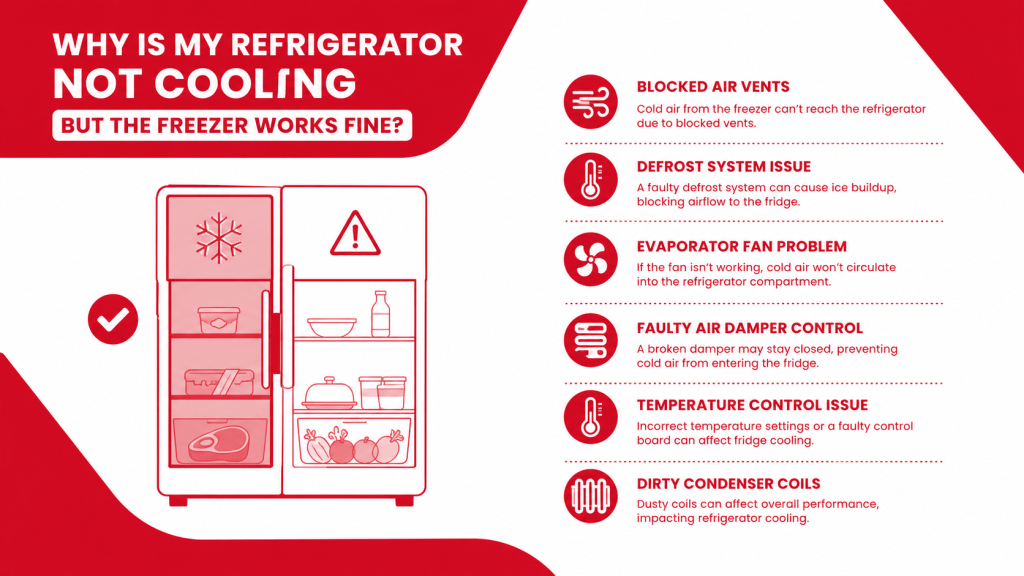
!Why Is My Refrigerator Not Cooling But the Freezer Works Fine? When your refrigerator stops cooling while the freezer stays cold, the most common cause is a failed evaporator fan motor or a blocked air damper that prevents cold air from transferring out of the freezer into the fresh food compartment.
Other frequent culprits include a faulty defrost system causing ice buildup on the evaporator coils, dirty condenser coils, or a defective thermistor. In most cases, the freezer and refrigerator share one cooling system, so when only one section loses temperature, the problem is almost always related to airflow rather than the compressor itself.
You open the fridge expecting a cold blast of air and instead get nothing. The milk is warm. The leftovers are sweating. But you peek into the freezer and everything in there is completely frozen solid, like nothing is wrong at all.
This is one of the most frustrating refrigerator problems homeowners in Sunrise, FL deal with, and it happens more often than people realize, especially in South Florida where the combination of high ambient temperatures and humidity puts extra strain on appliance cooling systems year round.
The good news is that this specific symptom, freezer cold, refrigerator warm, almost always points to a handful of specific components rather than a complete system failure. Understanding what is actually happening inside your refrigerator will help you decide whether this is something simple you can check yourself or whether it is time to call a licensed appliance repair technician.
How a Refrigerator’s Cooling System Actually Works
Before jumping into causes, it helps to understand the basic setup. Most modern refrigerators use a single evaporator coil located in the freezer compartment. A refrigerant circulates through this coil, absorbs heat, and creates cold air. The evaporator fan then pushes that cold air from the freezer into the fresh food section through a vent controlled by a component called the air damper or damper control assembly.
This means the freezer is always cooled first. The refrigerator section gets its cold air as a secondary transfer. If anything interrupts that airflow transfer, the freezer keeps humming along while the fresh food compartment warms up. That is the fundamental reason this symptom exists at all.
With that in mind, here are the most likely causes ranked from most common to least common.
1. Failed Evaporator Fan Motor
This is the number one cause of a refrigerator not cooling while the freezer remains cold. The evaporator fan is responsible for circulating cold air throughout both compartments. When the motor fails or the fan blade gets obstructed by ice, cold air stops moving into the refrigerator section entirely.
You can do a quick check by opening the freezer and listening for the fan running. If the fan goes silent when you press the door switch, that confirms it is working. If you hear nothing at all, or hear a grinding noise, the motor is likely failing.
On most Whirlpool, LG, Samsung, and GE refrigerator models, replacing an evaporator fan motor is a straightforward repair for a trained technician and typically resolves the problem completely. In Sunrise and Broward County, where temperatures regularly exceed 90 degrees Fahrenheit in summer, a failing evaporator fan causes more rapid temperature loss in the fresh food compartment than it would in cooler climates.
2. Frost or Ice Buildup on the Evaporator Coils
This is the second most common cause and it is directly connected to a failed defrost system. Inside the freezer, behind a back panel, sits the evaporator coil. A functional refrigerator runs automatic defrost cycles several times per day to prevent ice from accumulating on these coils.
If the defrost heater, defrost thermostat, or defrost timer fails, ice builds up on the coils over time until it completely blocks airflow. The freezer stays cold because the coil is still there, buried under ice, but the evaporator fan cannot push any air through the frozen blockage and into the refrigerator.
A telling sign of this problem is a refrigerator that gets worse gradually rather than failing all at once. Over the course of a week or two, you may notice the refrigerator getting progressively warmer while the freezer remains perfectly fine.
You can test this at home by unplugging the refrigerator for 24 to 48 hours with both doors open, allowing any ice buildup to melt, then plugging it back in. If the refrigerator cools normally afterward, you have confirmed a defrost system failure, but without fixing the underlying component, the ice will simply build up again.
3. Blocked or Stuck Air Damper
The air damper is a small door, sometimes called an air diffuser or damper control assembly, that sits between the freezer and refrigerator compartments. It opens and closes automatically to regulate how much cold air enters the fresh food section based on the thermostat reading.
When this damper gets stuck in the closed position, the freezer maintains its temperature just fine while the refrigerator gets no cold air at all. It is a mechanical issue that is easy to overlook because it requires no dramatic sounds or visible symptoms.
To check it, place your hand near the vent opening inside the refrigerator where cold air typically flows in. If you feel no airflow even when the freezer fan is running, a stuck damper is a strong possibility. On Frigidaire and KitchenAid models in particular, this component is known to fail prematurely and is one of the first things a trained technician will inspect.
4. Dirty Condenser Coils
Condenser coils release heat from the refrigerant out into the surrounding air. When these coils are coated in dust and debris, the refrigerant cannot shed heat efficiently, forcing the entire system to work harder. In Florida homes, where pet hair, dust, and high humidity are constant factors, condenser coils can become severely clogged faster than in dry climates.
When the condenser coils are dirty enough, the refrigerator section suffers first because it depends on a cascade of efficient cooling processes to maintain temperature. The freezer can often maintain adequate cold for longer because the evaporator coil sits directly in that compartment.
On refrigerators with coils located on the back or underneath the unit, cleaning them with a coil brush every six to twelve months is standard maintenance. Many homeowners in Sunrise are unaware this task even exists, which is why dirty condenser coils are one of the most common preventable causes of refrigerator repair calls.
5. Faulty Thermistordav
The thermistor is a temperature sensor inside the refrigerator compartment that communicates current temperatures to the control board. The control board uses this data to decide when to open the damper, run the evaporator fan, and trigger defrost cycles.
When the thermistor sends inaccurate readings, the control board may believe the refrigerator is already cold enough and never opens the damper to allow cold air in. The freezer, which has its own temperature sensing logic, continues operating normally because its cycle is unaffected.
A failing thermistor can be tested with a multimeter. If the resistance reading does not change as the temperature around the sensor changes, the component is defective. This is not typically a DIY-friendly repair because accessing the thermistor and testing it correctly requires familiarity with refrigerator wiring diagrams and component access procedures.
6. Malfunctioning Temperature Control Board
The main control board is the brain of the refrigerator. It coordinates every cooling cycle, defrost sequence, and airflow adjustment. When the control board develops a fault, it can send incorrect signals or stop sending signals altogether to the components responsible for cooling the refrigerator section.
This is a less common cause but one that becomes more prevalent in older refrigerators, particularly Samsung models where control board failures have been widely reported. A control board failure is typically diagnosed only after other components have been ruled out, since replacing a board without proper diagnosis wastes time and money.
7. Refrigerant Leak
A refrigerant leak is the most serious cause on this list and fortunately also one of the less common ones. Refrigerant, typically R134a in older units or R600a in newer models, flows through a sealed system. When a leak develops, cooling efficiency drops.
Interestingly, when refrigerant levels decline, the freezer section tends to hold temperature longer because the evaporator coil is directly in that space. The refrigerator section, which depends on secondary airflow, loses temperature first. You might notice the compressor running almost continuously without achieving proper cooling, and the refrigerator may feel slightly cool but never reach the proper temperature range of 35 to 38 degrees Fahrenheit.
Refrigerant repair requires EPA Section 608 certification and is strictly a job for a licensed appliance repair technician. Attempting to handle refrigerant without certification is both illegal and dangerous.
Why This Happens More in Broward County
Homeowners in Sunrise, Lauderhill, Tamarac, and the surrounding Broward County communities deal with a unique set of conditions that accelerate refrigerator component wear. The combination of year-round heat, high indoor humidity, and salty coastal air creates an environment where condenser coils clog faster, door gaskets deteriorate more quickly, and evaporator fan motors work harder than they would in a temperate climate.
During summer months when outdoor temperatures routinely push into the mid-90s, refrigerators located in garages or near windows face even greater strain. The condenser must work significantly harder to expel heat into already hot surrounding air, and the entire cooling system runs more frequent cycles to compensate. This accelerated wear pattern is why refrigerator problems that might develop over several years in a northern state can appear within a couple of years of purchase in South Florida — a pattern also seen by technicians at [Falcon Appliance Services](https://falconapplianceservices.com/) who service similar hot-climate conditions in Abilene, TX.
What the Correct Temperature Range Should Be
For food safety, the United States Food and Drug Administration recommends keeping the fresh food compartment at or below 40 degrees Fahrenheit and the freezer at 0 degrees Fahrenheit. In practical terms, most appliance technicians set refrigerators between 35 and 38 degrees for optimal performance.
If you have a thermometer inside your refrigerator and it is reading above 45 degrees Fahrenheit, food safety becomes a concern within two hours for perishable items such as dairy, raw meat, and cooked leftovers. Do not wait to address this problem if your temperatures have climbed to that range.
Repair vs. Replace: Applying the 50/50 Rule
Before calling for service, it is worth doing a quick cost assessment. The widely used 50/50 rule in appliance repair states that if the repair cost exceeds 50 percent of the cost of a new refrigerator and the unit has already lived more than half of its expected lifespan, replacement is often the smarter financial decision.
The average refrigerator has a lifespan of 10 to 15 years. An evaporator fan motor replacement or damper repair on a 4-year-old refrigerator is almost always worth doing. The same repair on a 13-year-old Frigidaire with a rusted cabinet and a cracked door liner is a different conversation.
Repair costs in the Sunrise and Broward County area for this type of problem typically range from $150 to $400 depending on the specific component and the refrigerator brand. Evaporator fan motors and thermistors tend to sit at the lower end of that range, while control boards and defrost system repairs can reach the higher end.
When to Call a Professional Appliance Repair Technician
You should contact a licensed appliance repair technician when:
The refrigerator has been warm for more than 24 hours and basic checks like clearing blocked vents and adjusting the thermostat have not changed anything.
The evaporator fan is not running and accessing it requires removing the freezer back panel.
You suspect a defrost system failure and want it properly diagnosed rather than temporarily resolved by manually defrosting.
The problem returns within a few weeks of manually defrosting, which confirms a component failure rather than a one-time ice buildup event.
You hear the compressor running constantly but the refrigerator never gets cold, which may indicate a refrigerant issue requiring EPA-certified handling.
In Sunrise, FL and the surrounding Broward County area, same-day and emergency refrigerator repair is available. Because refrigerators are used around the clock and contain perishable food, this is not the type of appliance problem to delay.
FAQs
Can I still use my refrigerator if only the freezer is working?
You can use the freezer for frozen items, but the refrigerator section should not be trusted for perishable food once temperatures exceed 40 degrees Fahrenheit. Move dairy, meat, and cooked food to a cooler with ice until the repair is complete.
How long does it take to fix a refrigerator that is not cooling?
Most repairs, including evaporator fan motor replacement, thermistor swap, and damper repair, are completed in a single visit by a qualified technician. Defrost system repairs may require a short wait for parts on less common models.
Will unplugging my refrigerator and plugging it back in fix the problem?
A hard reset can occasionally clear a temporary control board glitch, but it will not fix mechanical component failures. If the refrigerator cools normally for a day after a reset but warms up again, a defrost system issue is the likely cause.
Is it safe to eat food from a refrigerator that stopped cooling overnight?
The FDA recommends discarding perishable food that has been above 40 degrees Fahrenheit for more than two hours. When in doubt, throw it out.
Why does my Samsung refrigerator specifically have this problem?
Samsung refrigerators have been associated with ice maker and evaporator fan issues at higher rates than some competing brands. If you own a Samsung French door or side-by-side model and are experiencing this symptom, the evaporator fan motor and defrost system are the first components a technician will inspect.
Need Refrigerator Repair in Sunrise, FL?
If your refrigerator is warm and your freezer is cold, our licensed technicians at Appliance Repair Sunrise serve Sunrise, Lauderhill, Tamarac, Davie, Plantation, Weston, Oakland Park, and Fort Lauderdale with same-day service. We carry common parts for Whirlpool, LG, Samsung, GE, Frigidaire, KitchenAid, and Maytag refrigerators and back every repair with a 90-day parts and labor warranty. Call us at +1 954 513 4331 to schedule your repair today.